All specialist freelancers currently working in and around MedComms (specialist medical education, medical communications and medical
publishing activities) were invited to participate in the MedComms Freelancing Barometer in January 2026.
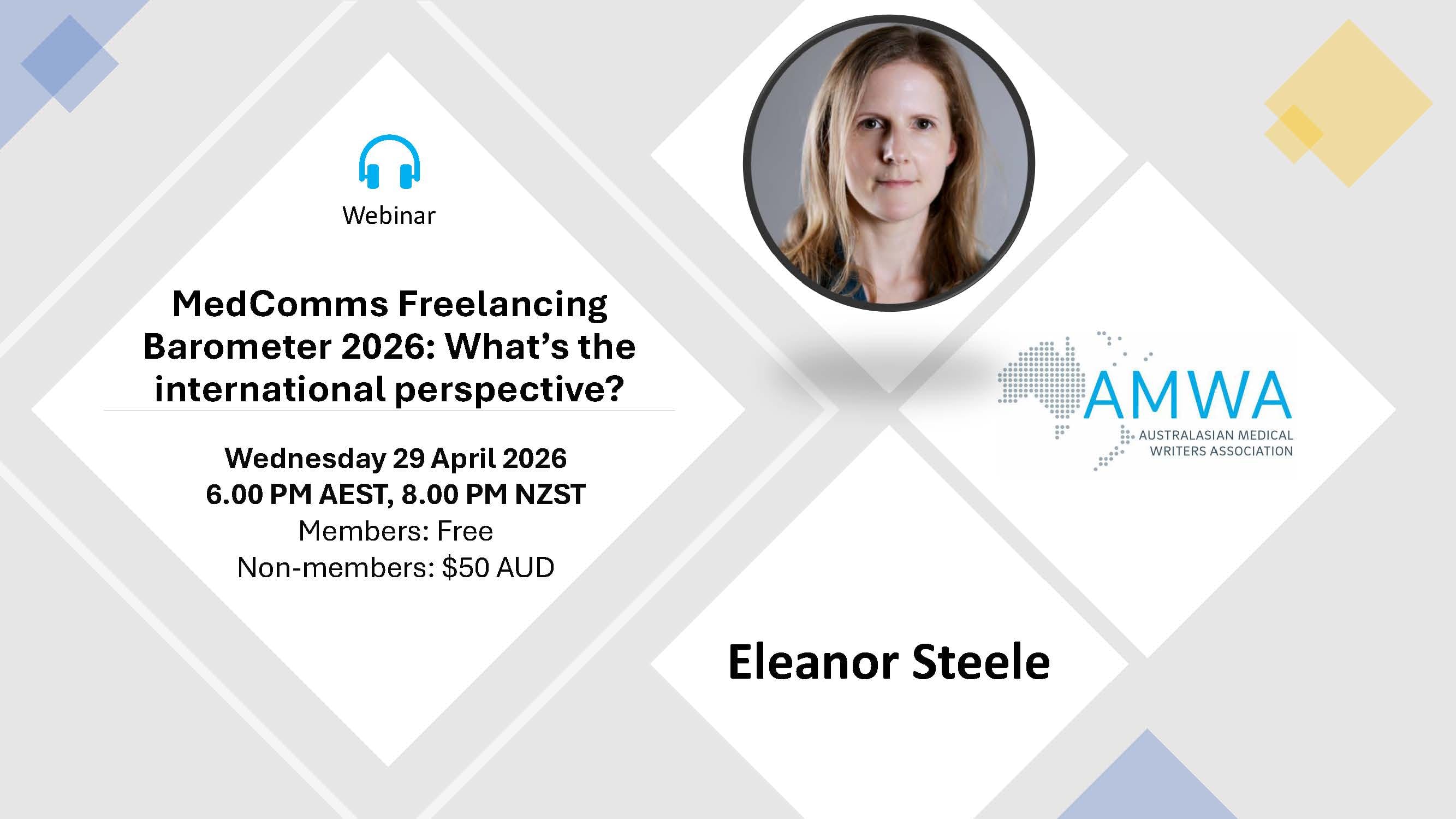
In this webinar, we’ll be joined by Eleanor Steele, Director of the MedComms Workbook, who ran the Barometer. She will dive into the
Barometer results and explore the emerging trends shaping the future of freelancing in MedComms globally, with a spotlight on data from the
Australasian respondents in comparison with other regions.
Eleanor Steele has worked in MedComms since 2004, first as a medical writer, then leading scientific teams in several different
agencies.
She is now a freelance consultant working as the MedComms Mentor to provide specialist
training and mentoring to medical writers
and consultancy to agencies around building and developing their medical writing teams. Since April 2024, she has also managed
the MedComms Workbook community for MedComms freelancers.
The digital age has profoundly changed the way people engage with each other and the world. The rapid pace of information flow, the rise of
social media influencers and the declining trust in governments and institutions requires a shift in the way the World Health Organization
(WHO) communicates with key stakeholders and the support it provides to its Member States. In the Western Pacific Region, WHO is responding
to this challenge and turning it into an opportunity though the Communication for Health (C4H) approach.
C4H recognises the power of communication as a tool for health. The approach harnesses insights from social, behavioural and communication
sciences to create more targeted, people-centred and impactful communication.
The recording of this webinar is available in our Members Area to AMWA members.
Read More…
Literature reviews often require you to find evidence outside peer-reviewed journal literature.
PRISMA 2020 includes a requirement to find ‘other sources’, often for free, so where do you search? what types are
of value? and how do you integrate these in your work?
Join Thelma Fisher, a Health Sciences Subject Librarian at the University of Otago, on Thursday October 14 2021 at
12:00pm AEDT/2:00pm NZDT to discover the answers to these questions.
This webinar is supported by the University of Otago and is available to AMWA members at no cost ($20 for
non-members).
Read More…
Join Thelma Fisher, a Health Sciences Subject Librarian at the University of Otago on Thursday 7 October 2021 at 12:00pm
AEDT/2:00pm NZDT, to:
Learn tips and techniques to make best use of PubMed when searching by MeSH, keywords or journals.
Integrate relevant search terms and filters to create effective search strategies for your literature review.
Save your searches and create alerts to keep up to date.
This webinar is supported by the University of Otago and is available to AMWA members at no cost ($20 for non-members).
Read More…
Sydney Networking Event
Come and be part of our first networking event of 2026, hosted by AMWA committee member, Ciara Duffy. The event is free-of-charge to all,
with some nibbles provided by AMWA. Non-members are welcome!